




Ceramic Heating Coil Versus Cotton Coil: Choosing the Better Fit
Introduction
When people compare a ceramic heating coil with a cotton coil, the real question is usually not "which one is better on paper?" It is "which one makes life easier in daily use?" In practice, that comes down to heat control, maintenance, lifespan, and how often you want to swap parts or deal with burnt taste.
Ceramic coils are built for long service life and steady performance. Cotton coils are cheaper to buy and can give a strong first impression, especially on flavor. But cotton wears out faster, and once it starts drying, scorching, or loading up with residue, the experience drops off quickly. That is the trade-off. One is built for endurance. The other gives you a cheaper start.
What are Heating Coils?
Heating coils are parts that turn electrical energy into heat. You see them in industrial heaters, HVAC systems, water heaters, and vaping devices. The basic idea is simple: current passes through a material that resists flow, and that resistance creates heat.
Some heating coils are designed to transfer heat directly through a metal element. Others move heat through steam or hot water in larger systems. In vaping, the coil is doing the work of heating liquid so it turns into vapor. What matters here is how evenly that heat is delivered and how long the coil can keep doing it without breaking down.
Types of Coil Materials
There are a few common coil materials, and each one behaves differently in real use.
Ceramic Heat Coil
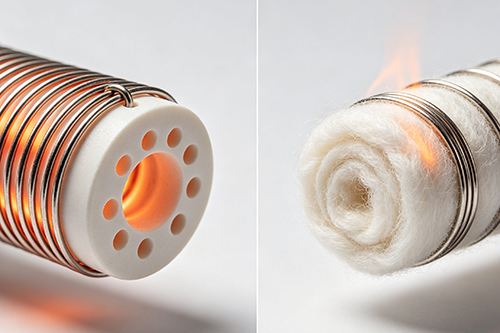
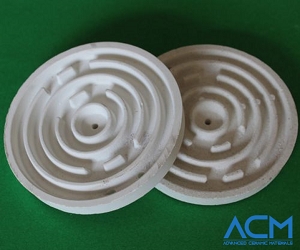
A ceramic heat coil is made using porous ceramic materials such as aluminum oxide, silicon carbide, or zirconia. The porous structure is important. It helps spread heat smoothly instead of creating hot spots. That gives more even performance and lowers the chance of dry hits or burnt wick problems.
Ceramic coils are popular where durability and stable heat matter. In vaping, they are often chosen for clean flavor and better longevity. In industrial use, they hold up well under high temperatures and repeated cycling.
Cotton Heating Coil
Cotton coils use natural fibers that soak up liquid fast. That fast wicking is their big advantage. The first few puffs can taste strong and lively because the liquid is fed quickly to the heated area.
But cotton has limits. It burns more easily if the coil runs dry or gets too hot. Over time, the fibers darken, clog, and break down. Once that starts, flavor slips and the burnt taste is usually not far behind.
Mesh Coils
Mesh coils are thin sheets of metal with a large surface area. They heat quickly and spread heat quite evenly. That usually gives strong flavor and dense vapor.
The downside is cost and compatibility. Not every device accepts mesh, and some users find they go through liquid faster. They can be very good, but they are not always the simplest choice.
Traditional Coils
Traditional coils are made from metal wire, often nichrome, kanthal, or stainless steel. These are the old reliable types. They work well in standard wattage setups and temperature control applications.
They are simple, familiar, and easy to source. For many users, they are still the practical middle ground.
How Ceramic Heating Coils Work
A ceramic heating coil works through resistive heating. Electricity passes through the heating element, and the ceramic structure helps distribute that heat across the surface more evenly.
The porous ceramic does two useful things. First, it helps heat spread steadily instead of concentrating in one point. Second, it supports the liquid or heating surface in a way that reduces dry spots. That means fewer harsh hits and a longer working life.
In everyday terms, ceramic does a better job of staying stable under repeated heat cycles. That is one reason these coils are often preferred where consistency matters.
Properties and Merits of Your Ceramic Heating Coil
High Temperature Resistance
Good ceramic materials can handle very high temperatures, well above what most users will ever need. Alumina and silicon carbide, for example, are known for holding up under extreme heat without melting or deforming.
That matters because a coil that stays intact under heat will last longer and behave more predictably.
High Stability
Ceramic is stable under harsh conditions. It does not easily warp or change shape when temperatures swing up and down. That helps in industrial machinery, but it also helps in smaller devices where repeated heating cycles can wear parts down.
High Mechanical Strength
Ceramic materials can be very strong, though they are also brittle. In practical terms, that means they resist wear, vibration, and impact better than many people expect, as long as they are handled properly.
Cracks are the real enemy. If the coil stays intact, it keeps doing its job far longer.
Consistent Vape Flavor
This is where ceramic often wins for vaping. Cotton can give a sharp, strong flavor at the start, but that often fades as the wick ages. Ceramic tends to keep flavor more stable over time. The vapor stays cleaner and more even because the heat delivery is steadier.
High Electrical Resistance
Ceramic heating elements are useful because they work well as part of a resistive heating system. The material supports controlled heat generation rather than uncontrolled current flow. That makes the coil behave more predictably.
Energy Efficiency
Compared with older coil setups, ceramic heating elements can be more efficient. In practice, faster heat-up and more even heat distribution mean less wasted energy. Over time, that can matter quite a bit in equipment that runs often.
Safety
Safety is another strong point. Ceramic surfaces are stable and less likely to burn through like organic wicking materials. That lowers the risk of wick burn and reduces the chance of sudden performance drop-off.
"After switching to ceramic heating coils in our systems, replacements reduced by 75% and energy wastage reduced by 35%." — Jane Oeltjen, Operations Engineer, Chencom Solutions
Drawbacks of Ceramic Heating Coils
Higher Initial Cost
Ceramic coils cost more upfront. That is mostly because the material and manufacturing process are more demanding. If someone is only looking at the purchase price, ceramic can seem expensive.
But the real question is total cost over time, not just the first bill.
Fragility
Ceramic is strong in service, but it can be brittle if dropped or knocked hard. A common mistake is treating it like a rugged metal part. It is not. It needs careful handling during installation and transport.
Properties and Merits of Cotton Coils
Strong Initial Flavor
Cotton often gives a very strong first flavor impression. For users who like a bright, immediate hit of taste, that can be attractive. Right out of the box, cotton can feel lively and responsive.
The problem is that it does not stay that way forever.
High Liquid Absorption
Cotton absorbs liquid quickly. That fast wicking is useful because it helps keep the coil fed during use. It also makes cotton easy to work with in many vaping devices.
Soft and Breathable
Cotton fibers are flexible and porous. That helps airflow and makes the material easy to fit into coil assemblies. It is one reason cotton has stayed common for so long.
Lower Initial Cost
Cotton coils are usually cheaper to buy at the start. For someone on a tight budget or someone who only needs short-term use, that can be the deciding factor.
Still, the lower upfront price often gets balanced out by more frequent replacement.
Disadvantages of Cotton Coils
Short Lifespan
Cotton burns and degrades with repeated heating cycles. Once the fibers start to break down, the taste changes fast. You may notice a dull flavour, then a scorched note, and then a full burnt taste. That is usually when replacement is due.
High Burnout Risk
Because cotton is organic, it is more vulnerable to dry hits and overheating. If the wick is not fully saturated, it can burn quickly. That is one of the most common problems people run into.
Frequent Maintenance
Cotton setups need more attention. Wicks need trimming, coils need cleaning, and parts need replacing more often. If you do not keep up with it, performance falls off fast.
Flavor Degradation
Cotton can taste great early on, but residue and heat damage build up over time. As that happens, flavor drops and burnt notes become more likely. That is why many users replace cotton parts much sooner than ceramic ones.
Cotton Versus Ceramic Coils Comparison Table
| Criterion | Ceramic Heating Coil | Cotton Coil |
|---|---|---|
| Lifespan | Higher durability, long service life | Shorter life, frequent replacements |
| Temperature resistance | Excellent, above 1700°C in advanced ceramics | Moderate |
| Mechanical strength | High strength, but brittle | Less brittle |
| Initial cost | Higher upfront | Lower upfront |
| Maintenance | Low maintenance, fewer replacements | Higher maintenance, frequent wick changes |
| Flavor stability | Long-term consistent flavor | Stronger at first, then degrades |
| Safety | Stable heating, lower wick burn risk | Higher risk of dry hit or burnt wick |
Why Your Ceramic Coil Is Preferred Over Cotton For Your Vape
If you are looking at long-term use, ceramic usually makes more sense. It gives steadier heat, fewer replacements, and more consistent flavour. Cotton may feel better at the start, but it asks for more attention and wears out faster.
For anyone who wants less hassle and better long-term value, ceramic is the safer pick. If you need dependable ceramic heating parts, Advanced Ceramic Materials (ACM) is one supplier worth checking for material support and product consistency.
Applications of Ceramic Heating Coils
Ceramic heating coils are used in more than vaping devices.
In HVAC and infrared heaters, they help deliver controlled heat reliably. In industrial ovens and machinery, they stand up to high temperatures without constant replacement. In medical devices, they support tighter thermal control where precision matters. And in water heaters, their resistance to corrosion and scaling gives them an edge over simple metal parts.
That wide use tells you something important: ceramic is not just about one niche. It is a practical material for situations where heat needs to be controlled, repeated, and dependable.
Heating Coil Selection Criteria: Ceramic Coil Vs Cotton Coil
Choosing between ceramic and cotton comes down to use case.
If you want lower upfront cost and strong initial flavor, cotton can work. Just be ready for more maintenance and shorter service life.
If you want a coil that lasts longer, handles heat better, and stays more consistent, ceramic is the better choice. A common mistake is buying only on price. That usually leads to more replacements and more frustration later.
For quality checks, always look at the build, heat tolerance, and whether the product meets the right standards for your application. In serious use, consistency matters more than a cheap first purchase.
Conclusion
When you put them side by side, the difference is clear. Cotton coils are cheaper at the start and can give a strong initial flavor. Ceramic heating coils cost more upfront, but they last longer, run more steadily, and are much less prone to wick burn.
If you want simple short-term use, cotton can be fine. If you want better durability, lower maintenance, and more reliable performance, ceramic is the better fit.
FAQs: Ceramic Vs. Cotton Coils
Q: How does a ceramic heating coil work?
A: It uses resistive heating. The porous ceramic helps spread heat evenly and reduces dry spots.
Q: Why are ceramic heating coils preferred over cotton coils?
A: They last longer, stay more stable under heat, and usually need less maintenance.
Q: Are ceramic coils safe for vaping?
A: Yes, when properly made and used in the right device. They have lower wick burn risk than cotton.
Q: Do ceramic coils last longer than cotton?
A: Yes. In practice, they usually last much longer because they do not burn down like cotton wicks.
Q: What are some drawbacks of ceramic heating coils?
A: Higher upfront cost and brittleness. They need a bit more care during handling.

{{item.content}}
LEVE A REPLY
{{item.children[0].content}}
{{item.content}}
LEAVE A REPLY
SUBSCRIBE OUR NEWSLETTER
- 5 Ways Alumina Ceramic Plates Keep Heavy Industry Running
- Oxide, Sulfide, or Phosphate? A Supplier's Guide to Solid-State Electrolyte Ceramics
- Alumina vs. Zirconia Ceramics: The Engineering Blueprint for Material Selection
- Case Study: Sub-Millimeter Sapphire Tubes for High Voltage Discharge Applications
- Alumina Powder (Al2O3): A Technical Guide to Grades, Properties, and Applications
 The Melting Behavior of Ceramics: A Technical Guide for High-Temperature Applications
This technical guide reviews how advanced ceramics melt. It gives key basics to help you pick materials for high-heat processes. It covers uses from furnace construction to semiconductor manufacturing.
READ MORE >
The Melting Behavior of Ceramics: A Technical Guide for High-Temperature Applications
This technical guide reviews how advanced ceramics melt. It gives key basics to help you pick materials for high-heat processes. It covers uses from furnace construction to semiconductor manufacturing.
READ MORE >