




Aluminum Nitride Ceramic Selection Guide for Custom Parts
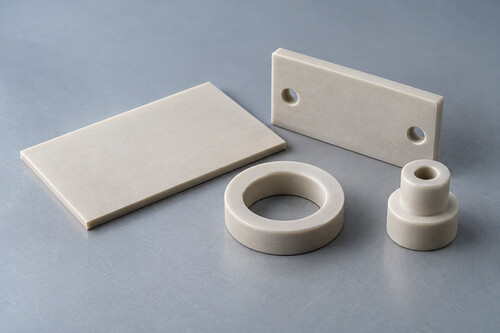
Aluminum nitride is often selected because it combines electrical insulation with high thermal conductivity. That description is accurate, but it is not enough to release a drawing or place an order. Two AlN parts with the same dimensions can perform differently because of ceramic grade, density, additives, thickness, surface condition, machining damage, and how the part attaches to the rest of the assembly.
The most reliable specification starts with the heat path and service conditions, then converts them into measurable requirements. Don't buy AlN based on a family-level property table alone. Ask for the actual grade, the property basis, the finished dimensions and surfaces, and the evidence needed to accept the part.
When Is Aluminum Nitride the Right Choice
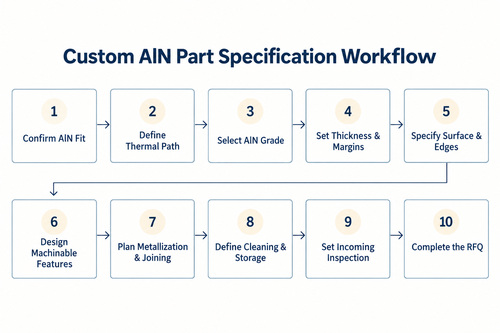
AlN is a strong candidate when a component must transfer heat while remaining electrically insulating. It is most valuable when the ceramic itself contributes meaningful thermal resistance. It is not automatically the best ceramic for every hot component: if heat flux is moderate, cost is the dominant constraint, or severe mechanical and thermal cycling controls service life, another material may provide a better balance. Confirm that improving conductivity through the ceramic will change the system temperature before paying for a higher-conductivity grade.
Begin With the Thermal Path, Not a Catalog Number
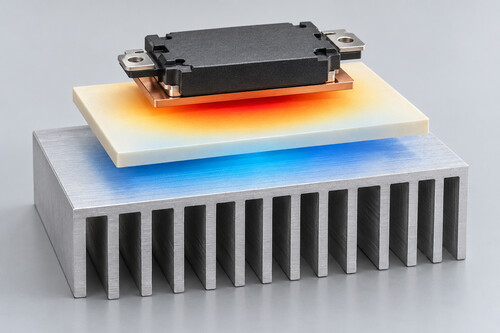
Before choosing a grade, map the complete path from the heat source to the coolant, chassis, or ambient air. The ceramic body is only one resistance in series. Die attach, solder or sintered layers, metallization, surface contact, thermal interface material, and the cooler can each control the result. A higher AlN conductivity will not fix a thick bond line, poor contact, or undersized heat-spreading area.
For one-dimensional conduction through a uniform plate, ceramic thermal resistance is approximately thickness divided by thermal conductivity and heat-transfer area. This simple relationship is useful for screening, but it does not include spreading resistance, edge losses, contact resistance, or nonuniform heat flux. Use the actual package geometry for final thermal analysis.
- Heat-source size, peak and continuous heat load, duty cycle, and allowable junction or surface temperature
- Direction of heat flow, available contact area, coolant or heat-sink condition, and mounting pressure
- Steady-state temperature and transient ramp rates, including start-up, shut-down, and fault events
- Voltage, creepage and clearance, insulation test method, and the consequence of dielectric failure
- Assembly interfaces, metallization, joining temperature, clamping method, and expected service life
Select the AlN Grade by Performance Requirements
Thermal conductivity is not a universal constant for every AlN ceramic. Oxygen-related defects, secondary phases, sintering additives, porosity, grain structure, and measurement temperature all influence the reported value. Single-crystal measurements and theoretical limits should not be used as purchasing values for a conventional polycrystalline finished part.
State a minimum or agreed typical conductivity only when it matters to the design, and define how the value is supported. A datasheet value may describe the starting material rather than every finished component. For a critical heat path, agree on the grade, nominal property range, test method or certificate basis, and whether lot-specific evidence is required.
|
Requirement |
Why it matters |
Useful specification language |
|
Material identity |
Different AlN formulations do not have identical thermal, dielectric, or machining behavior. |
Manufacturer grade or mutually approved equivalent; composition or purity limits when functionally necessary |
|
Thermal conductivity |
Controls temperature drop through the ceramic but varies with grade and temperature. |
Minimum or nominal value at a stated temperature; identify certificate or test basis |
|
Density and porosity |
Affect heat flow, dielectric performance, strength, sealing, and surface quality. |
Minimum bulk density or maximum open porosity when required by the application |
|
Electrical performance |
Breakdown behavior depends on thickness, surface condition, environment, and test setup. |
Test voltage, waveform, duration, electrode arrangement, environment, and acceptance criterion |
|
Temperature capability |
Air, vacuum, reducing atmosphere, and reactive process gases create different limits. |
Continuous and transient temperatures together with the actual atmosphere and exposure time |
Choose Thickness Together With Voltage and Mechanical Margin
Reducing thickness lowers conduction resistance, but it also reduces handling stiffness and may change electrical margin. Increasing thickness can make a part easier to handle while increasing the temperature drop through the ceramic. The right thickness therefore comes from a three-way review of heat flow, insulation, and mechanical loading rather than from a standard stock size alone.
Keep unsupported spans short and avoid point loading. If fasteners are required, define washers, bushings, torque, flatness of mating parts, and assembly sequence. A ceramic plate can crack from local bending even when the nominal compressive load appears low. Edge distance around holes and the transition from thick to thin sections also deserve specific review.
Define Flatness, Surface Finish, and Edge Condition by Function
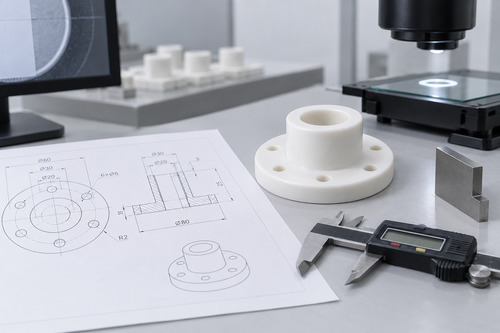
A tight dimensional tolerance is useful only when it protects an interface or assembly function. For bonded or clamped heat-transfer surfaces, flatness, parallelism, local waviness, and roughness can matter more than the overall length and width. Specify the measurement area, datum, and whether the value applies before or after metallization, plating, or another thermal process.
Do not request the lowest possible roughness automatically. A very smooth surface may support some thin bond lines or optical interfaces, while another joining process may need controlled texture. Surface finish also changes cost because it can require lapping or polishing after sintering. Give the joining method and target bond-line behavior so the ceramic supplier can recommend a practical finish.
- Identify functional faces and datums instead of applying one tolerance to every surface.
- Define maximum edge chips on sealing, bonding, electrical, and nonfunctional edges separately.
- Use radii or chamfers at corners and hole edges where the assembly allows them.
- State whether metallization, plating, cleaning, or joining occurs after ceramic inspection.
- Agree on cosmetic criteria with visual standards or measured limits, not subjective wording such as perfect.
Design Features Around Ceramic Machining Reality
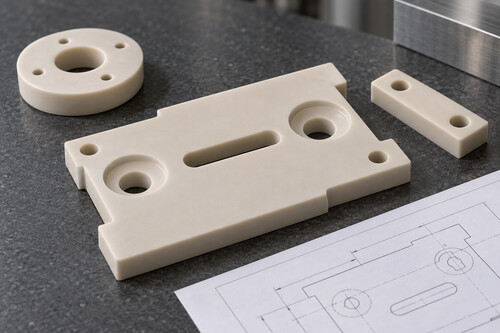
Fully sintered AlN is hard and brittle, so complex features are normally produced by diamond grinding, drilling, lapping, or related processes. Machining cost rises when a drawing combines thin walls, deep narrow slots, small holes, sharp internal corners, and tight positional tolerances. These features also reduce mechanical margin and can leave subsurface damage if the process is not controlled.
|
Drawing feature |
Risk to manage |
Practical direction |
|
Sharp internal corner |
Stress concentration and limited tool access |
Use the largest functional radius and identify true no-radius locations |
|
Hole near an edge |
Chipping, breakout, and reduced ligament strength |
Increase edge distance or add local material where the assembly permits |
|
Thin wall or web |
Handling fracture and grinding deflection |
Set a functional minimum thickness and review the production sequence |
|
Deep pocket or narrow slot |
Tool access, corner radius, slow material removal, hidden chips |
Open the geometry, allow a tool radius, or consider a near-net-shape route |
|
Many tight tolerances |
Inspection burden and unnecessary yield loss |
Apply tight limits only to mating and performance-critical features |
For prototypes, ask which dimensions can remain as-fired or as-lapped. For production, discuss whether near-net forming can remove machining operations. The best cost reduction usually comes from changing the drawing before qualification, not from negotiating after every feature has been locked.
Plan Metallization and Joining Before Finalizing the Ceramic
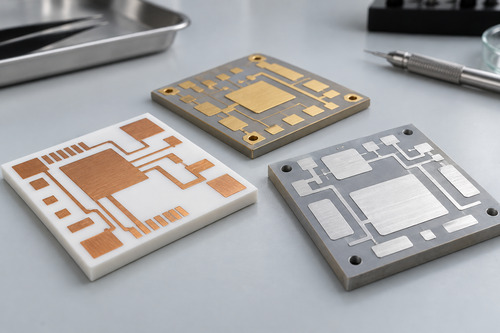
Bare AlN, thick-film or thin-film metallization, direct bonded copper, direct plated copper, and active-metal brazed assemblies have different surface, geometry, and thermal-cycle requirements. The metallization route affects allowable line geometry, bondability, conductor thickness, flatness, edge clearance, and subsequent plating. It should be selected with the ceramic grade and drawing, not added as an afterthought.
For circuitized parts, review the options on ACM's aluminum nitride substrate page and metal-coated ceramic substrate page. If the requirement is a structural or thermal component rather than a circuit substrate, start from custom-machined AlN parts and provide the downstream joining process with the drawing.
Control Moisture, Cleaning, and Storage
AlN can react with water under unfavorable conditions, and the risk depends on material condition, temperature, exposure time, chemistry, and surface protection. This does not mean every finished AlN part fails in normal handling. It does mean that cleaning and humidity exposure should be treated as qualified process conditions rather than left undefined.
Identify aqueous cleaning, ultrasonic cleaning, steam, high-humidity storage, coolants, and condensation in the final assembly. Keep parts clean and dry, avoid unapproved aggressive solutions, and use packaging appropriate to the storage period and destination. When moisture exposure is unavoidable, qualify the finished surface or protective system under representative time, temperature, and humidity conditions.
Build an Incoming Inspection Plan That Matches the Risk
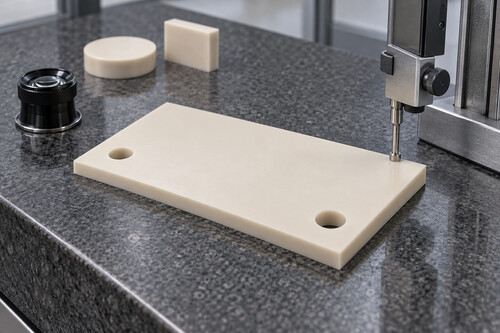
Receiving inspection should verify the requirements that control assembly yield and field reliability. Checking only length, width, and thickness can miss a bowed heat-transfer surface, edge damage at a high-field location, or a surface condition that prevents bonding. Conversely, repeating expensive material tests on every piece may add cost without improving control.
- Confirm part number, revision, quantity, material grade, lot identity, and certificate requirements.
- Measure critical dimensions, flatness, parallelism, and surface roughness using the agreed method and sampling plan.
- Inspect edges, holes, metallized areas, and functional faces under defined lighting and magnification.
- Use electrical, hermetic, bond, or thermal tests only when they connect to a real failure mode and have clear acceptance limits.
- Keep first-article evidence separate from routine lot inspection; process capability can justify a different production sampling plan.
What to Include in the RFQ
|
RFQ item |
Information to provide |
|
Application and environment |
Part function, temperature profile, atmosphere, humidity, voltage, heat load, mechanical loads, and expected life |
|
Material |
AlN grade or required property range, conductivity basis, density or purity limits when necessary, and approved equivalents |
|
Drawing and model |
Revision-controlled 2D drawing, 3D model, datums, critical-to-function dimensions, edge and chip criteria |
|
Surface and interfaces |
Flatness, parallelism, roughness, lapping or polishing, metallization, plating, joining method, and keep-out areas |
|
Quality evidence |
Certificate content, first-article report, inspection method, sampling plan, traceability, packaging, and labeling |
|
Commercial needs |
Prototype quantity, annual demand, target schedule, qualification stages, and forecast for process selection |
Advanced Ceramic Materials (ACM) supplies aluminum nitride ceramic materials and components, substrates, and custom-machined parts. For a manufacturability review, send the drawing, service conditions, interface details, and inspection requirements through the inquiry form.
Conclusion
Selecting AlN for a custom component requires more than confirming that the material offers high thermal conductivity. A useful specification defines the grade and property basis, connects thickness to the complete thermal and electrical design, identifies functional surfaces, respects brittle machining limits, controls cleaning and moisture exposure, and states how the finished part will be accepted. These details reduce quotation ambiguity, prevent avoidable machining cost, and make prototype results easier to transfer into production.
References
- G. A. Slack, R. A. Tanzilli, R. O. Pohl, and J. W. Vandersande, "The Intrinsic Thermal Conductivity of AlN," Journal of Physics and Chemistry of Solids, 48(7), 641–647, 1987. NIST Structural Ceramics Database record.
- Z. Cheng et al., "Experimental Observation of High Intrinsic Thermal Conductivity of AlN," Physical Review Materials, 4, 044602, 2020. doi:10.1103/PhysRevMaterials.4.044602.
- Fukumoto, T. Hookabe, and H. Tsubakino, "Hydrolysis Behavior of Aluminum Nitride in Various Solutions," Journal of Materials Science, 35(11), 2743–2748, 2000. doi:10.1023/A:1004718329003.
- ASTM E1461-13(2022), Standard Test Method for Thermal Diffusivity by the Flash Method.

{{item.content}}
LEVE A REPLY
{{item.children[0].content}}
{{item.content}}
LEAVE A REPLY
SUBSCRIBE OUR NEWSLETTER
 Alumina vs. Zirconia Ceramics: The Engineering Blueprint for Material Selection
This article compares their physical properties, real-world trade-offs, and cost-benefit realities to help you select the right ceramic for your operating environment.
READ MORE >