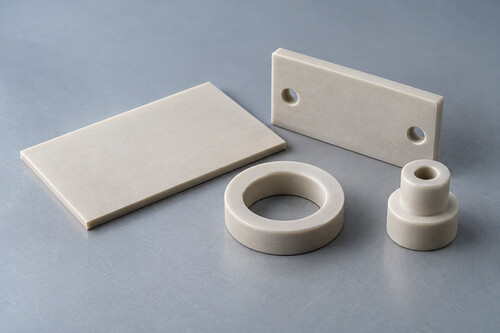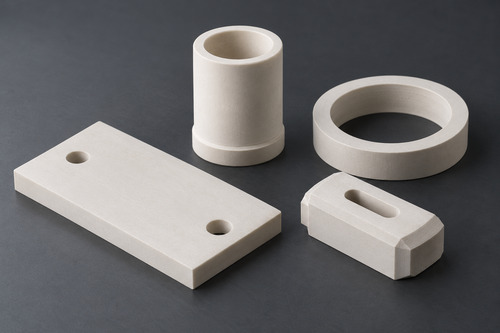





How to Choose Ceramic Seal Ring Materials for Pumps
A ceramic seal ring is rarely chosen on hardness alone. The pumped liquid, the mating face, heat at the interface, and what happens during startup usually matter more than a single property on a datasheet.
This is why two pumps with similar pressure and temperature ratings may need different seal-face materials. One runs continuously with clean water. The other starts and stops, occasionally loses flush, and carries fine crystals after cooling. Their "normal" operating data may look similar, but the seal faces do not see the same duty.
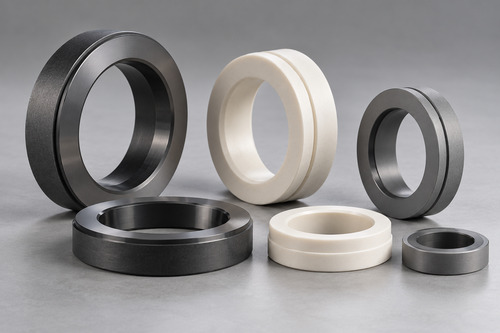
For most demanding pump applications, silicon carbide is the first material worth examining. Alumina remains practical in controlled service. ZTA and silicon nitride become more interesting when chipping, impact, or thermal shock—not gradual wear—is the main concern.
Begin with The Operating Problem
Before selecting a ceramic, identify the condition most likely to disturb the seal faces. Four questions usually reveal more than a long property comparison:
- Does the liquid contain hard particles, precipitates, or crystals?
- Can the faces run with limited lubrication during startup or a flush interruption?
- Will the ring see rapid temperature changes or uneven heating?
- Did the previous part wear gradually, or did it chip or crack first?
The answer helps separate a tribology problem from a mechanical one. A ring with deep circular scoring suggests a different response from a ring that has fractured around a drive slot.
| Operating concern | Material to evaluate first | Point to verify |
|---|---|---|
| Abrasive or corrosive liquid, higher speed, frictional heat | Silicon carbide | SiC grade, fluid compatibility, lubrication, and counterface |
| Clean liquid, moderate duty, stable lubrication | Alumina | Thermal margin, face flatness, and edge condition |
| Chipping or crack growth in an alumina-based design | ZTA | Actual composition and whether heat remains the real limitation |
| Impact, vibration, or rapid thermal change | Silicon nitride | Sliding behavior with the proposed mating face |
Silicon Carbide Is Not One Material
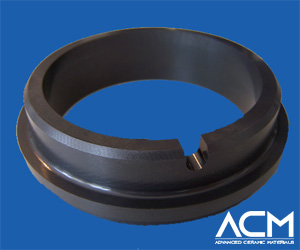
A silicon carbide seal ring combines high hardness, chemical resistance, wear resistance, and useful thermal conductivity. That combination explains its wide use in chemical pumps, slurry handling, and faster-running mechanical seals.
The grade still matters. Pressureless-sintered SiC has a different composition from reaction-bonded SiC, which contains residual free silicon. That phase may restrict its use in certain chemicals even when the bulk material is described simply as SiC.
Graphite-containing and porous grades are also available. They may improve behavior where lubrication is marginal, but they should not be treated as general-purpose dry-running solutions. Pressure, speed, counterface, liquid, and the length of the lubrication interruption all affect the result.
The drawing should therefore name the SiC grade or define the required composition and properties. "Black silicon carbide ring" is not an adequate purchasing specification.
Alumina Still Has a Place
Alumina can work well with clean liquids, moderate speed, steady temperature, and dependable lubrication. In this operating window, it offers a useful balance of hardness, chemical stability, availability, and cost.
Problems often begin with an event that was missing from the original review: a dry startup, a batch containing hard solids, or excessive interference between the ring and holder. Alumina is less forgiving than SiC when local heat builds quickly, and it offers less resistance to crack growth than ZTA or silicon nitride.
Purity is only one part of the specification. Density, grain structure, lapped-face quality, edge defects, and flatness after mounting can have a direct effect on leakage and service life.
Zta and Silicon Nitride Solve Different Problems
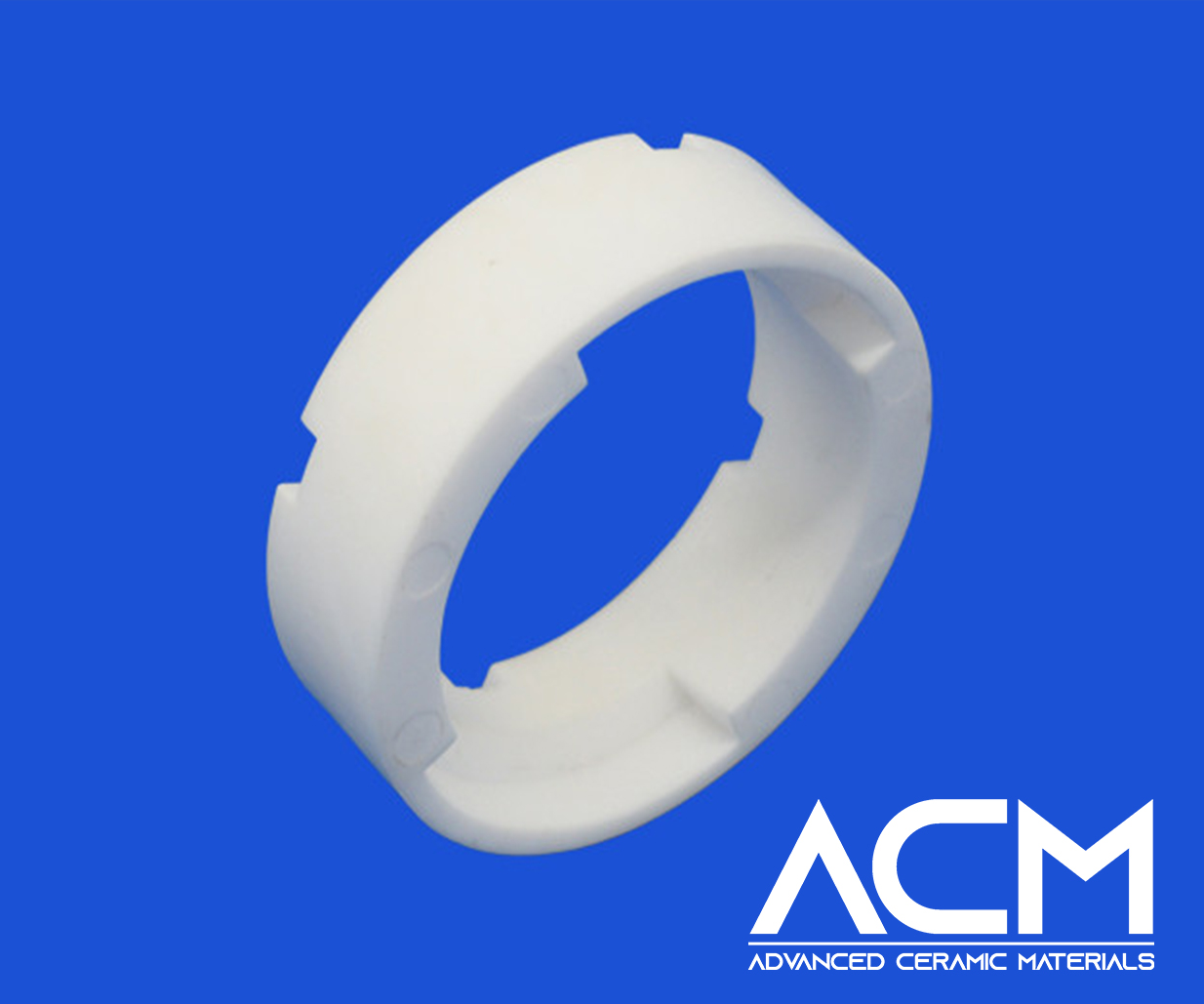
A zirconia-toughened alumina seal ring is useful when an alumina-based face is otherwise suitable but needs more resistance to chipping or crack propagation. This may matter in thin rings, parts with slots or notches, and components exposed to handling damage during assembly.
ZTA is not simply "better alumina." Zirconia content, stabilizer, microstructure, and processing route vary by grade. More toughness also does not correct an overheated interface. If the old face is heavily scored but not cracked, investigate particles and lubrication before changing to ZTA.
A silicon nitride seal ring becomes a stronger candidate when fracture occurs before significant wear. Its strength, fracture toughness, and thermal-shock resistance are helpful where vibration, impact, or rapid temperature change drives failure.
Its mechanical advantages do not settle the tribology. Sintering additives, surface finish, liquid chemistry, and counterface still influence friction and wear.
The Mating Face Changes the Answer
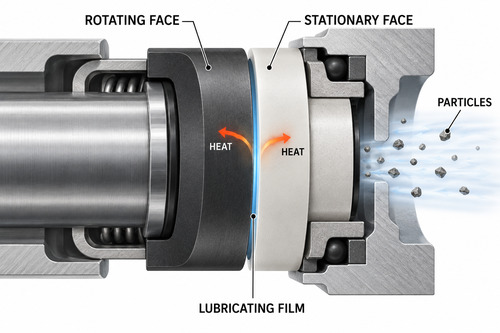
A mechanical seal works as a pair. Ceramic against carbon behaves differently from SiC against SiC. A carbon face can accommodate small alignment errors and act as the sacrificial member. A hard-hard pair offers better abrasion resistance but is less forgiving when lubrication or flatness is poor.
Select the rotating and stationary faces together. Record the grade on both sides, along with any carbon impregnation, the functional face, required finish, and flatness.
ACM lists Ra ≤ 0.2 µm as a typical finish for its SiC seal rings, with finer lapped finishes available. Roughness alone is not enough. Waviness, pullout, embedded lapping debris, or mounting distortion can still prevent stable face contact.
Use the Old Ring as Evidence
When a seal is removed, keep both faces and note their installed positions. Useful observations include:
- Circumferential grooves: check solids, flush quality, and loose debris.
- Wear concentrated on one side: check alignment, holder distortion, and mounted flatness.
- Radial cracks: review thermal shock, interference, and mechanical support.
- Chips at slots or drive features: review handling and local stress concentration.
These patterns are clues rather than proof. The operating event immediately before leakage is often just as important as the mark on the ring.
Information to Include with An RFQ
Identify the sealing face on the drawing. State the roughness parameter, flatness requirement and measurement method, critical edges, and any press-fit or shrink-fit condition. Avoid applying unnecessarily tight tolerances to every surface.
For the application, provide the liquid and concentration range, solids and particle size if known, temperature, pressure, shaft speed, mating-face material, flush arrangement, and possible periods of poor lubrication. Photographs of failed faces are useful when replacing an existing design.
For a new grade or geometry, a small first-article lot can reveal more than another line of general requirements. Inspect the faces before installation and again after a defined operating interval.
Final Selection
Use SiC as the starting point when abrasion, corrosion, speed, or heat dominates. Keep alumina in consideration for clean and stable service. Move toward ZTA when chipping limits an otherwise suitable alumina design. Consider silicon nitride when impact, thermal shock, or fracture is the recurring failure mode.
Then specify the grade, mating pair, finish, flatness, edge condition, and mounted geometry. The ceramic family name alone leaves too much open.
Advanced Ceramic Materials (ACM) supplies standard and custom ceramic seal rings in silicon carbide, ZTA, silicon nitride, and other technical ceramics. Drawings and operating conditions can be reviewed before quotation.
References
- API Standard 682, Pumps—Shaft Sealing Systems for Centrifugal and Rotary Pumps. American Petroleum Institute.
- ISO 21049:2004, Pumps—Shaft Sealing Systems for Centrifugal and Rotary Pumps. International Organization for Standardization.
- X. Zhao, Y. Liu, Q. Wen, and Y. Wang, "Frictional Performance of Silicon Carbide under Different Lubrication Conditions," Friction 2(1), 58–63 (2014). https://doi.org/10.1007/s40544-014-0039-1
- V. Presser et al., "Tribological and Hydrothermal Behaviour of Silicon Carbide under Water Lubrication," Wear 266(7–8), 771–781 (2009). https://doi.org/10.1016/j.wear.2008.08.005

{{item.content}}
LEVE A REPLY
{{item.children[0].content}}
{{item.content}}
LEAVE A REPLY
SUBSCRIBE OUR NEWSLETTER

 How to Choose a Metal Coated Ceramic Substrate
Choose a metal-coated ceramic substrate by comparing alumina, AlN, and Si3N4 bases, metal stacks, thickness, circuit layout, joining, and inspection needs.
READ MORE >