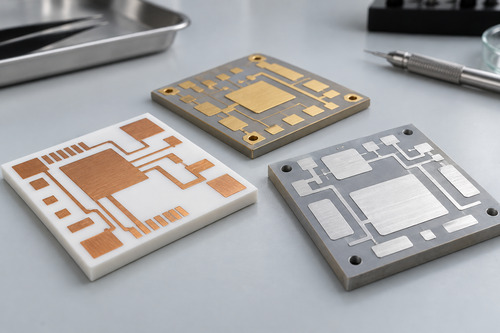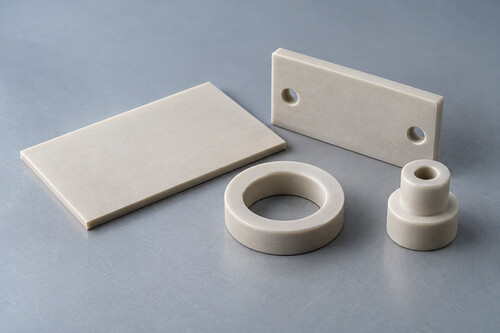





Boron Nitride Ceramic Grade Selection Guide for Machined Parts
A drawing that says only "boron nitride" does not identify a purchasable ceramic grade. Hot-pressed BN can be self-bonded or produced with oxide, nitride, or ceramic additions that change strength, moisture resistance, thermal behavior, electrical performance, machinability, and compatibility with molten materials. Two white BN parts with the same dimensions can therefore behave very differently in service.
Start with the atmosphere, temperature profile, electrical function, mechanical load, and contact materials. Then select a grade family and orient the part, geometry, machining plan, cleaning method, and inspection around those requirements. This guide focuses on the decisions needed to release a useful drawing and RFQ rather than on family-level property claims.
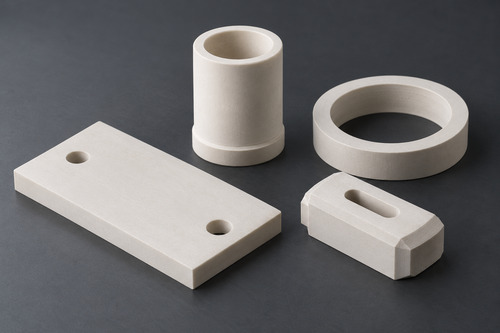
Begin With the Service Environment
A maximum-temperature number is meaningful only with an atmosphere and exposure time. A BN component may serve well at high temperature in vacuum or an inert gas yet face a different limit in air, steam, oxygen-bearing process gas, or contact with a reactive melt. Heating and cooling rates also matter because thermal gradients can combine with fixture restraint and section changes to create local tensile stress.
- Continuous and peak temperature, dwell time, ramp rate, and expected number of cycles
- Vacuum level or gas composition, including oxygen, water vapor, reactive species, and pressure
- Materials touching the BN, such as molten metal, graphite, heater alloys, salts, process deposits, or fixtures
- Electrical voltage, frequency, leakage-current limit, and whether the part is an insulator, spacer, or heat spreader
- Loads during assembly and use, including clamping, impact, vibration, sliding contact, and thermal restraint
Treat Grade Names as Supplier Specific
Terms such as high-purity BN, general-purpose BN, moisture-resistant BN, ZSBN, and BN-AlN describe useful grade families, but they are not universal specifications. Binder chemistry, additive content, density, orientation, and processing vary. A familiar name from one supplier should not be assumed equivalent to another grade with a similar label.
Use the ACM boron nitride material page for an initial view of available forms, then confirm the exact composition and grade-specific data for the finished part. Where substitution is allowed, define the functional limits an alternate grade must meet instead of approving it from the name alone.
|
Grade family |
Typical reason to consider it |
What must be verified |
|
High-purity or self-bonded h-BN |
Purity, electrical insulation, vacuum use, low contamination, and easy machining |
Density, strength, orientation, oxidation or moisture limits, surface condition, and allowable load |
|
Oxide-bonded BN |
General-purpose machinability and cost balance |
Binder type and content, moisture response, outgassing, chemical compatibility, and temperature limit |
|
Moisture-resistant bonded BN |
Handling or service where humidity exposure cannot be tightly controlled |
Actual humidity resistance, storage instructions, electrical behavior after exposure, and cleaning restrictions |
|
BN-ZrO2 or related ZSBN |
Higher strength, wear resistance, thermal shock, or molten-metal handling |
Phase composition, density, machinability, contamination risk, erosion, and compatibility with the melt |
|
BN-AlN composite |
A balance of machinability, strength, insulation, and heat transfer |
BN/AlN ratio, anisotropy, thermal data direction, machining damage, and service atmosphere |
Match the Grade to the Dominant Failure Mode
The best grade is not the one with the highest value in every column. If fracture during assembly is the primary risk, strength and flaw control may matter more than maximum purity. If the component sits in a high-vacuum source, binder chemistry, outgassing, cleaning residue, and particle generation may control acceptance. A nozzle or break ring in molten-metal service requires compatibility and erosion resistance that an electrical spacer does not.
Convert the failure concern into evidence. For insulation, state the actual voltage test and environment rather than requesting "high dielectric strength." For thermal management, identify the direction of heat flow and temperature at which the property matters. For molten-material contact, provide the alloy or melt chemistry, temperature, exposure time, flow velocity, and whether contamination or sticking is the limiting concern.
Account for Anisotropy and Pressing Direction
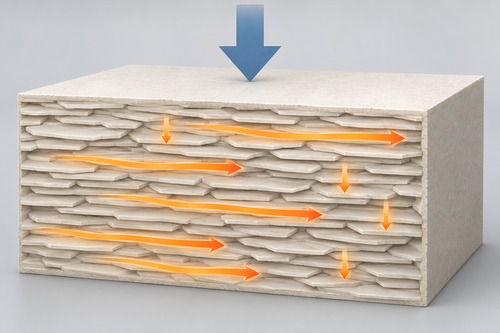
Hexagonal BN is a layered material. Hot pressing tends to orient the plate-like grains, so thermal, mechanical, and dimensional behavior can differ parallel and perpendicular to the pressing direction. A single thermal conductivity number without direction can be misleading, especially for a heat-spreading plate, heater support, or component with a large aspect ratio.
Show the required heat-flow direction, critical load direction, and finished-part orientation on the drawing or purchase specification. Ask whether the quoted values apply parallel or perpendicular to the pressing direction and how the blank will be cut. For complex shapes, confirm that the orientation remains consistent across prototypes and production lots.
Design Geometry for a Machinable but Brittle Ceramic
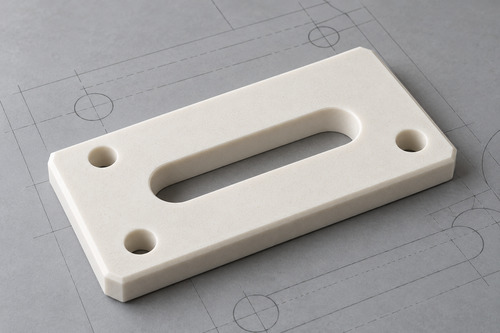
BN is easier to machine than dense alumina or silicon carbide, but machinable does not mean metal-like. Thin ligaments, sharp internal corners, deep narrow slots, unsupported walls, and fine threads can chip or break during machining, cleaning, transport, or assembly. The drawing should distinguish functional features from areas where a larger radius, edge break, or wider tolerance is acceptable.
Custom-machined hot-pressed BN parts can be produced in complex shapes, but the most economical geometry still gives the tool access, supports fragile sections, and avoids unnecessary finishing. Discuss threads before release: a coarse BN thread may be feasible in a sufficiently robust section, while a metal insert, clamp, or redesigned joint may be safer for repeated assembly.
- Use radii at internal transitions and chamfers or controlled edge breaks on handled edges.
- Keep wall thickness reasonably uniform and avoid abrupt changes near holes or clamping points.
- Provide enough edge distance around holes, slots, counterbores, and threaded features.
- Identify the few dimensions, datums, flatness zones, and surfaces that affect function.
- Specify permitted chips by size and location instead of using an undefined "chip free" requirement.
Specify Tolerances and Surface Finish by Function
Blank size, part geometry, grade, feature access, tool path, and inspection method all affect achievable tolerance. A tight tolerance demonstrated on a short solid spacer should not be applied automatically to a long thin tube or a plate with multiple pockets. Over-tolerancing increases machining time and rejection risk without improving the assembly.
Define datums and measurement conditions for flatness, parallelism, hole position, and concentricity. If a surface seals, transfers heat, supports a wafer, or carries a deposited layer, state the roughness parameter, measurement direction, cutoff or filter standard, and exact controlled area. Cosmetic appearance alone is not a reliable proxy for surface condition.
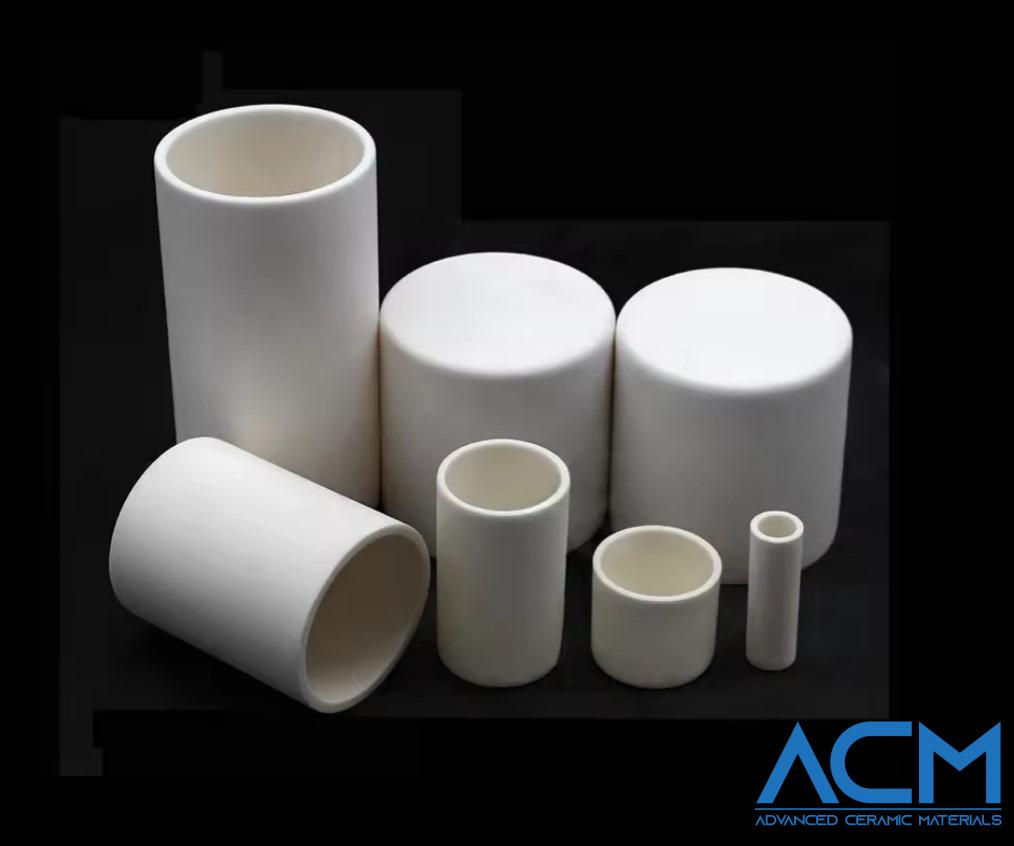
For tubular parts, use the custom boron nitride tube page as a form reference, but place the actual OD, ID, wall, straightness, concentricity, end condition, and thread requirements on the RFQ drawing.
Plan Cleaning Handling and Storage Before Release
Porosity and binder chemistry influence how a BN part responds to water, solvents, fingerprints, vacuum bakeout, and humid storage. A cleaning method suitable for one grade can leave residue, introduce absorbed moisture, or damage another. Do not add ultrasonic cleaning, aqueous washing, or a generic solvent requirement without confirming compatibility with the selected grade.
Agree on final cleaning, drying, packaging, desiccant or barrier bag requirements, shelf storage, and whether the customer will perform a bakeout before use. Handle thin edges and threaded features with protective packaging that prevents part-to-part contact. If vacuum performance matters, define the required cleanliness or outgassing evidence rather than assuming that high nominal purity is sufficient.
Build an Inspection Plan Around Real Risks
Incoming inspection should verify the features that determine assembly and service performance. Begin with grade and lot identity, critical dimensions, datums, surface condition, and edge damage. Add electrical, thermal, chemical, vacuum, or mechanical testing only when it connects to a defined failure mode and a repeatable acceptance criterion.
- Confirm grade designation, composition or binder family, lot traceability, and certificate requirements.
- Measure critical dimensions using an agreed sampling plan and support condition.
- Inspect functional surfaces, holes, slots, threads, and edges under defined lighting and magnification.
- Record orientation or pressing direction when directional properties affect the design.
- Separate first-article evidence from routine production-lot inspection and define change-control expectations.
What to Include in the RFQ
- Dimensioned drawing and, where useful, a 3D model with datums and functional surfaces identified
- Preferred BN grade or the service requirements needed for the supplier to recommend a grade
- Temperature profile, atmosphere, vacuum level, contact materials, and expected service duration
- Heat-flow and load directions together with any pressing-direction requirement
- Critical tolerances, surface finish, edge condition, permitted chips, and inspection method
- Cleaning, packaging, documentation, first-article, quantity, and production forecast requirements
A useful RFQ does not need to prescribe every manufacturing step. It should make the functional constraints visible so the supplier can identify conflicts before machining begins. For a manufacturability review, send the drawing and service conditions through the ACM inquiry form together with the required quantity and inspection evidence.
Conclusion
Selecting a machinable BN ceramic is a system decision. Grade chemistry, atmosphere, temperature, anisotropy, geometry, surface requirements, cleaning, and inspection must support the same failure-prevention strategy. Specify the environment and function first, treat trade names and family labels cautiously, and reserve tight requirements for features that affect performance. That approach produces a part that can be manufactured, inspected, handled, and qualified rather than merely a drawing that names boron nitride.
Advanced Ceramic Materials (ACM) supplies hot-pressed boron nitride materials and custom-machined BN components. If the grade is not yet fixed, send us the operating atmosphere, temperature range, drawing, critical tolerances, and expected quantity. Our team can review grade suitability and manufacturability before quotation.
References
1. P. Jiang, X. Qian, R. Yang, and L. Lindsay, "Anisotropic Thermal Transport in Bulk Hexagonal Boron Nitride," Physical Review Materials 2, 064005 (2018). doi:10.1103/PhysRevMaterials.2.064005.
2. N. S. Jacobson, G. N. Morscher, D. R. Bryant, and R. E. Tressler, "High-Temperature Oxidation of Boron Nitride," Journal of the American Ceramic Society 82 (6), 1473–1482 (1999). doi:10.1111/j.1151-2916.1999.tb01942.x.
3. "Oxidative and Hydrolytic Stability of Boron Nitride — A New Approach to Improving the Oxidation Resistance of Carbonaceous Structures," Carbon 33 (10), 1385–1390 (1995). doi:10.1016/0008-6223(95)00067-S.
4. ASTM C1161-18(2023), Standard Test Method for Flexural Strength of Advanced Ceramics at Ambient Temperature. ASTM International.

{{item.content}}
LEVE A REPLY
{{item.children[0].content}}
{{item.content}}
LEAVE A REPLY
SUBSCRIBE OUR NEWSLETTER
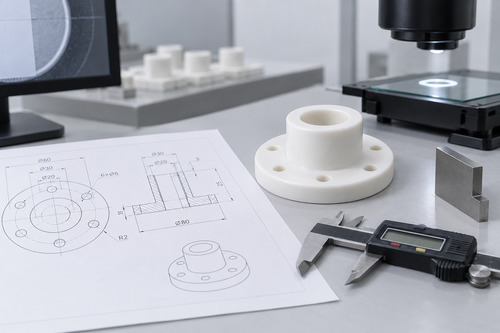 How to Specify a Custom Ceramic Part
Learn how to specify custom ceramic parts using functional tolerances, datums, surface finish, flatness, inspection requirements, and quote-ready drawings.
READ MORE >