




Heat-Resistant Ceramic Materials for Custom Parts
A material described as “heat resistant” may still fail in a furnace, burner, heater, or molten-metal system. The problem is usually not that the ceramic reached its melting point. More often, a rapid temperature change creates a steep thermal gradient, a metal fixture prevents expansion, a process gas reacts with the ceramic, or a thin feature carries more load than expected.
This makes maximum-temperature figures a poor starting point for a custom part. The useful question is narrower: which ceramic grade can keep the required strength, electrical behavior, dimensional stability, and chemical cleanliness throughout the actual heating and cooling cycle?
Start with the temperature history, not one temperature
An RFQ that states only “1,200°C operating temperature” leaves out several decisions. Is 1,200°C the furnace setpoint, the gas temperature, or the measured temperature of the part? Does the ceramic remain there for ten minutes or ten days? Does it heat evenly, or is one face exposed to a flame while the other touches a cooled fixture?
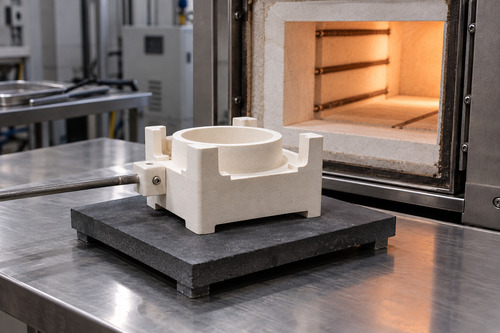
The heating and cooling rate can be more important than the peak value. A thick alumina plate warmed slowly and uniformly may survive a temperature that cracks the same material when a cold workpiece is placed on it. Open holes, sharp section changes, blind corners, and rigid mounting points make these gradients more difficult to tolerate.
A practical first screen
The table below is a starting point rather than a universal ranking. Commercial grades within one ceramic family can differ in porosity, additives, free phases, grain size, orientation, and oxidation behavior.
| Material | Where it often fits | Main point to verify |
|---|---|---|
| Alumina | Furnace tubes, insulators, thermocouple protection, fixtures under steady heat | Thermal gradient, purity, creep or load at temperature, and edge condition |
| Silicon carbide | Kiln furniture, burner parts, nozzles, heat-transfer components, high-wear hot zones | SiC grade, free silicon or porosity, oxidation, and chemical exposure |
| Silicon nitride | Parts exposed to rapid cycling, impact, vibration, or combined heat and mechanical load | Grade, sintering additives, oxidation limit, and sustained high-temperature load |
| Boron nitride | Vacuum or inert-atmosphere insulators, heater supports, crucibles, and easily machined parts | Atmosphere, oxidation, material direction, binder system, and mechanical load |
| Zirconia | Thermal barriers, low-heat-transfer components, or parts needing toughness at moderate temperature | Phase stability, thermal expansion, thermal cycling, and service-temperature range |
| Aluminum nitride | Electrically insulating parts that must move heat away from a source | Moisture protection, oxidation conditions, joint design, and required thermal conductivity |
Alumina is the baseline for steady high-temperature service
Alumina custom parts are widely used because alumina combines electrical insulation, hardness, chemical stability, availability, and a broad range of shapes. Tubes, sleeves, plates, spacers, and thermocouple protection components are all familiar uses.
Alumina performs best when temperature changes are controlled and the component is well supported without being clamped rigidly. Its limitations become more visible with concentrated heating, abrupt quenching, impact, or a design that places the ceramic in tension. A higher-purity alumina grade may improve chemical cleanliness and high-temperature capability, but purity alone does not correct a severe thermal gradient or poor mounting arrangement.
Silicon carbide handles heat flow and hot-zone wear
Silicon carbide ceramic is often a stronger candidate when a part must conduct heat, resist abrasion, and remain stable in a hot zone. Its relatively high thermal conductivity and low thermal expansion help reduce temperature differences within the part, which is one reason SiC is used for kiln furniture, heat exchangers, burner components, and nozzles.
The specific SiC type must be named. Reaction-bonded SiC contains residual free silicon and has different temperature and chemical limits from pressureless-sintered or recrystallized SiC. Recrystallized material can offer high purity and thermal-shock performance but is more porous and generally carries load differently from a dense sintered grade.
Silicon nitride is useful when fracture occurs before slow degradation
Custom silicon nitride products deserve attention when the part sees rapid temperature changes together with impact, vibration, or mechanical load. Silicon nitride has low thermal expansion and better fracture toughness than many monolithic ceramics. NASA literature has long identified its resistance to thermal shock and high-temperature corrosion as a reason for using it in demanding structural components.
Reaction-bonded, gas-pressure-sintered, hot-pressed, and other forms do not share the same density, strength, or high-temperature behavior. Specify the grade and review the temperature, exposure time, atmosphere, and load rather than approving a part from the family name alone.
Boron nitride depends strongly on atmosphere and direction
Hot-pressed boron nitride custom parts can be machined into complex insulators, heater supports, spacers, and crucibles without the extensive diamond grinding required by hard ceramics. BN also offers electrical insulation, thermal-shock resistance, and low wettability against many molten materials.
Its impressive vacuum or inert-atmosphere temperature capability should not be copied into an air application. Oxidation can become the controlling limit well below the temperature tolerated under vacuum. Binder-containing grades also behave differently from high-purity hot-pressed BN, while pyrolytic BN is strongly anisotropic because of its layered deposition structure.
Zirconia and aluminum nitride solve narrower thermal problems
Zirconia is useful when low thermal conductivity or higher fracture toughness is more valuable than rapid heat transfer. It is used in thermal-barrier and wear applications, but its comparatively high thermal expansion and temperature-dependent phase stability require careful grade selection. It should not be treated as the default answer simply because it is tougher than alumina at room temperature.
Aluminum nitride is selected mainly when an electrically insulating part must remove heat from electronics, heaters, or semiconductor equipment. Moisture exposure, oxidation, and joining conditions must be considered. For a furnace structural part with no thermal-management requirement, another ceramic may be simpler.
The mounting design can decide whether the ceramic survives
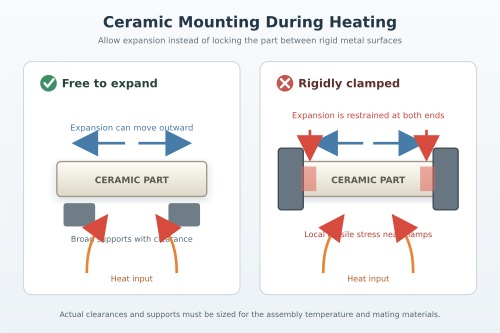
A ceramic part should be allowed to expand relative to a metal frame. Metal bolts, clamps, or interference fits can introduce high local stress as the assembly heats, even when the ceramic itself remains below its allowable temperature. Use broad support surfaces, controlled clearances, compliant layers where appropriate, and radiused transitions instead of point contact and sharp internal corners.
What to include in a useful RFQ
Provide more than the furnace temperature. A supplier needs:
- Minimum, normal, and maximum part temperature, including heating and cooling rates
- Air, vacuum, inert gas, reducing gas, steam, or reactive process atmosphere
- Exposure duration, number of cycles, and known upset conditions
- Mechanical load, support points, vibration, impact, and mating materials
- Contact with molten metal, glass, salts, powders, plasma, or cleaning chemicals
- Electrical insulation, thermal conductivity, purity, and contamination limits
- Dimensioned drawing with functional surfaces, tolerances, and critical edges
- Quantity, inspection method, and whether a prototype or first-article test is planned
Final selection
Use alumina as the baseline for steady, electrically insulating high-temperature parts. Move toward SiC when heat transfer, wear, or hot-zone chemical stability dominates. Consider silicon nitride when rapid cycling and mechanical damage drive failure. Use BN where vacuum or inert atmosphere, machinability, electrical insulation, or non-wetting behavior matters. Select zirconia or AlN only when their more specialized thermal behavior matches the application.
Then define the grade, atmosphere, time at temperature, cycle rate, load, geometry, mounting method, and inspection plan. A maximum-temperature figure can eliminate an obviously unsuitable material, but it cannot finish the selection.
Advanced Ceramic Materials (ACM) supplies standard and custom components in alumina, silicon carbide, silicon nitride, boron nitride, aluminum nitride, zirconia, and other technical ceramics. Drawings and operating conditions can be reviewed before quotation.
References
- R. K. Govila, “Evaluation and Ranking of Candidate Ceramic Wafer Engine Seal Materials,” NASA Technical Memorandum 103795 (1991). https://ntrs.nasa.gov/citations/19910014202
- G. Ziegler, J. Heinrich, and G. Wötting, “Silicon Nitride: A Ceramic Material with Outstanding Resistance to Thermal Shock and Corrosion,” NASA Technical Reports Server, Accession No. 19840008268. https://ntrs.nasa.gov/citations/19840008268
- A. J. Eckel and I. P. Herbell, “Thermal Shock of Fiber Reinforced Ceramic Matrix Composites,” NASA Technical Memorandum 103743 (1991). https://ntrs.nasa.gov/citations/19910009982

{{item.content}}
LEVE A REPLY
{{item.children[0].content}}
{{item.content}}
LEAVE A REPLY
SUBSCRIBE OUR NEWSLETTER

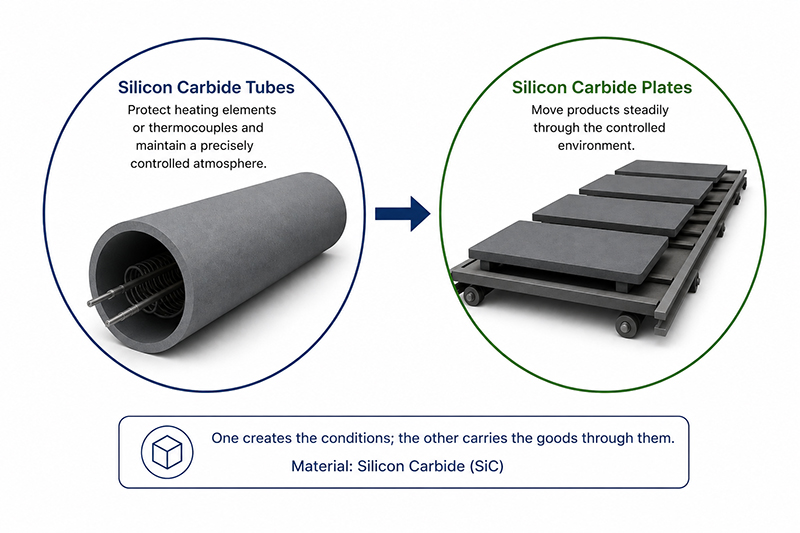 Why Do Kilns Need Both SiC Plates and SiC Tubes?
Silicon carbide plates and tubes share a material heritage. They share thermal shock resistance, high-temperature strength, and chemical durability. But in practice, they couldn't be more different in what they're asked to do.
READ MORE >