Do you have any questions? Email Us
[email protected]







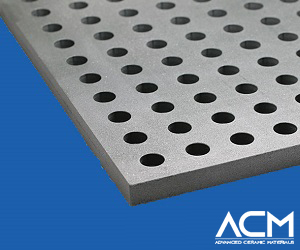
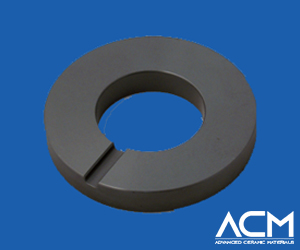
SC0977 Silicon Carbide Gasket, SiC Gasket
- Catalog No. SC0977
- Molecular Formula SiC
- Molecular Weight 40.1
- Appearance Black
- Melting Point 2,730° C (4,946° F) (decomposes)
- Density 3.0 to 3.2 g/cm3
- Electrical Resistivity 1 to 4 10x Ω-m
- Poisson's Ratio 0.15 to 0.21
- Specific Heat 670 to 1180 J/kg-K
Datasheet
Inquiry
SC0977 Silicon Carbide Gasket, SiC Gasket
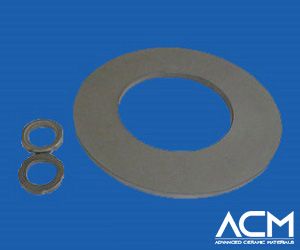
Silicon Carbide Gasket Description
Silicon Carbide (SiC) gaskets from Advanced Ceramic Materials (ACM) provide reliable static sealing solutions for high-temperature, corrosive, and vacuum environments. Engineered for flange connections, pipe joints, heat exchanger seals, and furnace doors, these precision-machined gaskets maintain sealing integrity under extreme conditions where metallic and polymer gaskets fail prematurely.
Silicon Carbide Gasket Specifications
| Physical Property | Value |
|---|---|
| Material | Silicon Carbide (SiC) |
| Color | Black |
| Density | 3.0 – 3.2 g/cm³ |
| Hardness | Hv ≥ 26 GPa |
| Melting Point | 2730°C (decomposes) |
| Max. Service Temp (Oxidizing) | 1600°C |
| Electrical Resistivity | 1 – 4 × 10⁻² Ω·m |
| Poisson's Ratio | 0.15 – 0.21 |
| Specific Heat | 670 – 1180 J/kg·K |
Available Grades – Sintered vs. Reaction-Bonded
| Type | Grade | Description | Purity | Recommended Use |
|---|---|---|---|---|
| Sintered SiC (S-SiC) | SMB1 | Basic pure SiC | > 98% | General chemical-resistant static seals |
| Sintered SiC (S-SiC) | SMG1 | Graphite-impregnated | > 98% | Self-lubricating gaskets for dry sealing |
| Sintered SiC (S-SiC) | SMP1 | Porous SiC | > 98% | Vented or permeable seal applications |
| Reaction-Bonded SiC (RB-SiC) | SMB2 | Basic SiC | > 88% | Cost-effective general-purpose gaskets |
| Reaction-Bonded SiC (RB-SiC) | SMG2 | Graphite-impregnated | > 88% | Low-friction static seal applications |
Silicon Carbide Gasket Applications
- Chemical Processing – Flange gaskets for piping systems handling aggressive acids, chlorinated solvents, and caustic media
- High-Temperature Furnaces – Door seals and viewport seals for industrial kilns and heat treatment furnaces
- Heat Exchangers – Gaskets for shell-and-tube and plate-type heat exchangers operating at elevated temperatures
- Vacuum Systems – Sealing components for vacuum chambers and thin-film deposition equipment
- Semiconductor Manufacturing – Process chamber seals where metallic contamination must be avoided
Quality Assurance
Every SiC gasket shipment from ACM includes a complete Certificate of Analysis (COA) documenting:
- Chemical composition and SiC purity
- Dimensional inspection report
- Density and hardness measurements
- Visual inspection for surface defects
ACM maintains ISO-compliant quality systems to ensure lot-to-lot consistency and full material traceability.
Packing Service
- Individually packaged to prevent edge chipping and surface damage
- Custom kitting available for multi-component seal assemblies
- US-based inventory for standard sizes
Frequently Asked Questions
What is the maximum operating temperature for SiC gaskets?
Sintered SiC gaskets can operate continuously at temperatures up to 1600°C in oxidizing atmospheres. For reducing atmospheres or vacuum conditions, please consult ACM's technical team for specific recommendations.
Are SiC gaskets suitable for flange sealing in aggressive chemical service?
Yes. Silicon carbide exhibits exceptional corrosion resistance to most mineral acids, organic acids, and caustic solutions, making it an excellent choice for demanding chemical processing flange connections.
What gasket thicknesses are available?
ACM offers standard thicknesses from 1mm to 20mm in various profiles. Custom thicknesses and non-standard shapes are available upon request.
Can SiC gaskets withstand thermal cycling?
Yes. SiC's low thermal expansion coefficient and high thermal conductivity provide excellent thermal shock resistance, allowing gaskets to survive repeated temperature cycling without cracking.
What is the difference between sintered SiC and reaction-bonded SiC for gaskets?
Sintered SiC offers higher purity (>98%) and superior chemical resistance, making it ideal for corrosive media applications. Reaction-bonded SiC contains 8–12% free silicon, providing slightly lower chemical resistance but better cost efficiency for less demanding static seals.
 Preview
 Download

Request a Quote
-
Attachment (Optional)
No file chosen
Related Products

Tel : (949) 407-8904
Address : 1940 E Deere Ave #100 Santa Ana, CA 92705 U.S.A.
Main Products

Useful Links
Featured Posts