




Ceramic Insulators: Types, Materials, and How to Choose
Start with The Job the Insulator Must Do
A ceramic insulator may separate a live conductor from a metal housing, support a heating element, isolate a thermocouple junction, or carry heat away from a power device without carrying current. Those jobs do not point to the same ceramic material. Alumina is a dependable starting point for many structural insulators, while aluminum nitride is used when electrical isolation must be combined with strong heat transfer. Boron nitride becomes attractive in vacuum equipment or where a complex insulating part needs to be machined from a blank.
The drawing matters as much as the ceramic family. Voltage across a thin wall, voltage traveling along a contaminated surface, and an electric field concentrated at a metal edge create different risks. Temperature, frequency, humidity, atmosphere, mechanical load, and cleaning conditions must therefore be defined before comparing datasheet values. International standards classify ceramic and glass materials for electrical insulation, but final approval still depends on the grade, geometry, and test conditions used for the finished component.
A Quick Material Screen
|
Application priority |
Material to consider first |
Main reason |
What still needs checking |
|
General electrical isolation with structural support |
Balanced insulation, strength, temperature capability, and availability |
Purity, wall thickness, surface finish, edge condition, and thermal cycling |
|
|
Electrical isolation plus rapid heat removal |
Much higher thermal conductivity than conventional alumina grades |
Moisture exposure, surface condition, grade-specific conductivity, and joining design |
|
|
Vacuum or inert-gas service with complex machined geometry |
Machinability, electrical insulation, and useful high-temperature behavior in controlled atmospheres |
Oxidation, binder system, moisture sensitivity, anisotropy, and mechanical load |
|
|
Thermocouple or heating-element support |
Magnesium oxide or alumina |
High-temperature electrical isolation in tubes, beads, and multi-bore shapes |
Porosity, moisture, chemical contact, atmosphere, and required mechanical strength |
|
Lower-cost electrical hardware at moderate duty |
Steatite or technical porcelain |
Economical forming and established use in electrical components |
Temperature, strength, dimensional accuracy, and dielectric loss |
|
Prototype or intricate insulating fixture |
Machinable glass-ceramic or machinable BN |
Features can be produced without firing a dedicated hard-ceramic shape |
Service temperature, vacuum compatibility, strength, and long-term dimensional stability |
Alumina Is the Baseline, Not the Automatic Answer
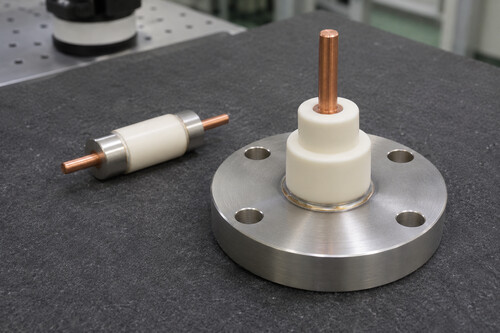
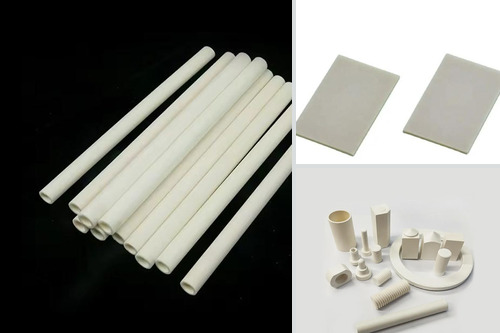
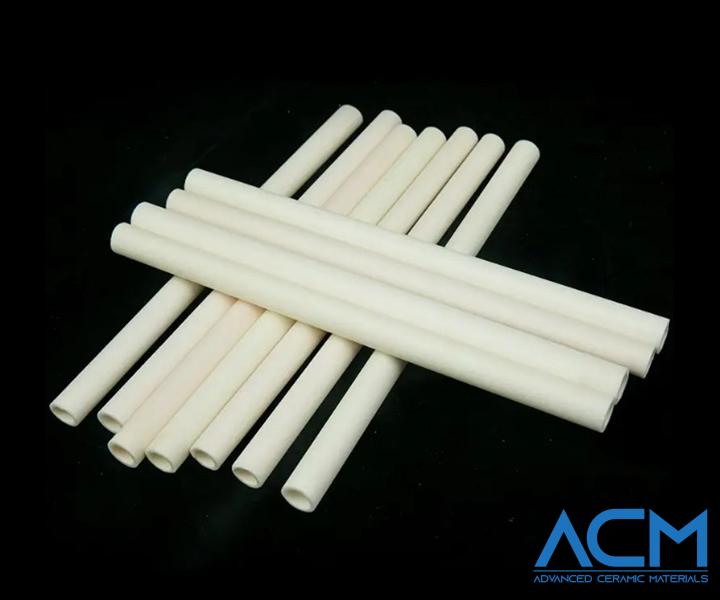
For feedthrough bodies, spacers, sleeves, standoffs, sensor housings, and furnace insulation, alumina often offers the most practical balance. It is hard, chemically stable, electrically resistive, and available in established forming and finishing routes. Alumina ceramic tubes, for example, can combine conductor separation with mechanical protection in furnaces, analytical equipment, and thermocouple assemblies.
Purity alone does not determine whether an alumina insulator will survive high voltage. Grain size, pores, glassy grain-boundary phases, surface damage, and contamination can influence charge transport and breakdown. Research on high-voltage alumina shows that microstructure and intergranular phases affect resistance to dielectric failure. A polished, clean specimen tested under controlled laboratory conditions should not be treated as proof that a drilled, metallized, or handled production part will deliver the same result.
Alumina is usually a practical choice when the part must provide electrical insulation while also carrying a mechanical load or resisting wear at elevated temperatures. It becomes less suitable when heat must pass through the insulator quickly, or when the design includes complex features that would be costly to grind into a dense ceramic. Parts exposed to steep temperature gradients also need a closer look, since local thermal stress may control the design.
Use Aluminum Nitride when Insulation and Heat Flow Are Equally Important
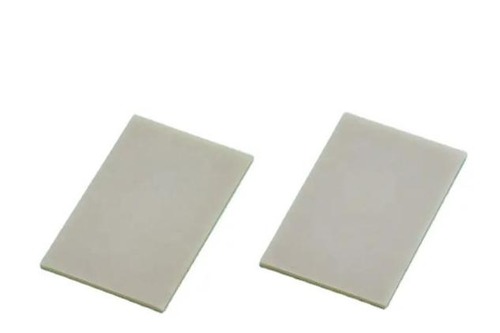
An electrical insulator can also trap heat. That is acceptable in a terminal block but undesirable beneath a power semiconductor, laser diode, heater, or high-power resistor. In these assemblies, aluminum nitride substrates provide electrical isolation while moving heat toward a heat sink or cooled structure. Reviews of AlN processing emphasize that powder purity, oxygen content, densification, and grain-boundary chemistry strongly affect the thermal performance of the fired ceramic.
AlN should not be selected from a headline thermal-conductivity value alone. Ask for the value associated with the offered grade and thickness, then review surface flatness, metallization, attachment method, and coefficient-of-thermal-expansion compatibility. Moisture and cleaning procedures also deserve attention, especially before metallization or bonding. If heat flow is not a governing requirement, alumina may offer a simpler and more economical route.
Boron Nitride Solves a Different Insulation Problem
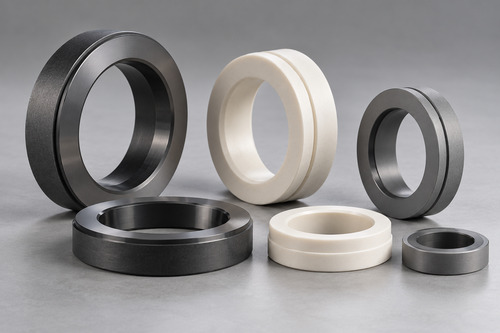
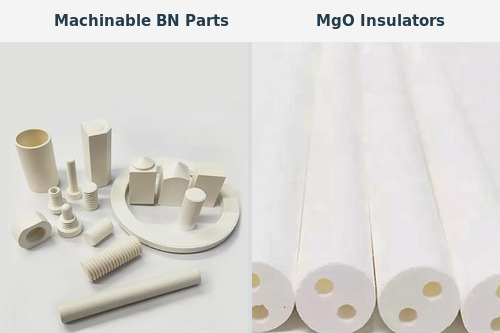
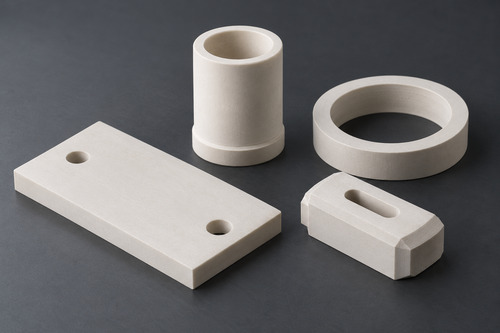
Hot-pressed boron nitride is useful for heater supports, vacuum feedthrough components, spacers, ion-source parts, and other insulators that need slots, pockets, bores, or low-volume custom geometry. Boron nitride custom machined parts can be produced from consolidated blanks without the diamond grinding normally required for dense alumina.
The trade-off is that "boron nitride" does not identify one interchangeable grade. Self-bonded high-purity BN, oxide-bonded BN, moisture-resistant grades, and BN composites differ in strength, outgassing, humidity response, and contamination risk. The layered crystal structure also makes thermal and mechanical behavior directional. A value reported parallel to the pressing direction may not represent performance through the thickness.
BN is therefore not a general upgrade over alumina. It fits when machinability, vacuum cleanliness, thermal shock behavior, or non-wetting performance justifies its limitations. Air exposure at high temperature must be reviewed separately from vacuum or inert-gas service.
Magnesium Oxide, Steatite, and Glass-Ceramics Fill Narrower Roles
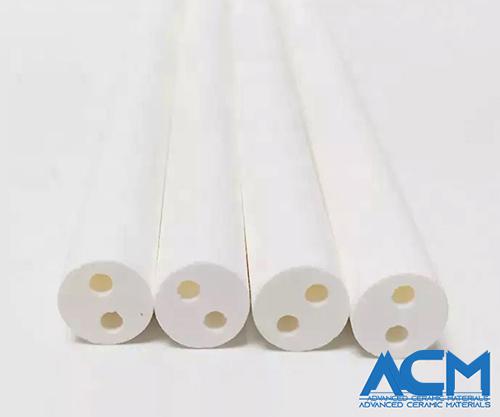
Magnesium oxide insulators are closely associated with thermocouples and mineral-insulated heating assemblies. MgO electrically separates the conductors while allowing heat to reach or leave the sensing junction. Because moisture can reduce insulation resistance, storage, sealing, drying, and assembly practice may matter as much as the nominal composition.
Steatite and technical porcelain remain useful where cost, formability, and established electrical performance matter more than extreme purity or thermal conductivity. Machinable glass-ceramics serve prototypes, laboratory fixtures, and complex low-volume parts, but their temperature and strength limits must be checked against the real assembly. These materials should be chosen for a defined operating window rather than because they are easy to machine or mold.
Voltage Rating Cannot Be Copied Directly from A Material Datasheet
Dielectric strength is typically reported as electric field at breakdown under specified specimen and test conditions. It is not a universal voltage rating for every part made from that ceramic. A thicker part does not always scale linearly, and surface flashover may occur before current punctures the bulk material.
Review at least five design details:
-
Wall thickness: the shortest path through the ceramic between conductors.
-
Creepage distance: the path along the surface, including grooves and contamination-prone areas.
-
Metal-edge geometry: sharp edges can concentrate the electric field near the ceramic.
-
Environment: humidity, deposits, vacuum, pressure, and gas composition can change the failure mode.
-
Frequency and waveform: DC, AC, pulses, and radio-frequency service place different demands on loss, charging, and heating.
Mechanical design belongs in the same review. A ceramic sleeve can pass an electrical test and still crack from clamp load, impact, misalignment, or differential thermal expansion. Radiused transitions, protected edges, controlled assembly clearances, and compliant metal features often improve reliability more than specifying a higher nominal dielectric strength.
Information to Put in An RFQ
Give the supplier enough information to select both the ceramic family and the grade:
-
Normal, peak, and transient voltage; AC or DC; frequency and pulse conditions
-
Required bulk insulation path and surface creepage distance
-
Normal and peak temperature, heat source location, ramp rate, and cycle count
-
Air, vacuum, inert gas, pressure, humidity, chemicals, plasma, or deposited contamination
-
Heat-flow requirement and allowable temperature rise
-
Mechanical load, mounting method, mating materials, vibration, and impact
-
Critical dimensions, surface finish, metallization, brazing, bonding, and cleanliness
-
Required electrical, leak, dimensional, or thermal test method and acceptance level
Advanced Ceramic Materials (ACM) supplies standard and custom insulating components in alumina, aluminum nitride, boron nitride, magnesium oxide, and other technical ceramics. For a useful material review, send the drawing together with the electrical conditions, temperature profile, atmosphere, mating materials, and inspection requirements. The best ceramic insulator is the one whose grade, shape, and test method match the complete assembly—not the material with the highest number in a single datasheet column.
References
-
International Electrotechnical Commission. IEC 60672-1:1995, Ceramic and Glass Insulating Materials—Part 1: Definitions and Classification.
-
International Electrotechnical Commission. IEC 60672-3:1997, Ceramic and Glass-Insulating Materials—Part 3: Specifications for Individual Materials.
-
M. Touzin et al. Alumina Based Ceramics for High-Voltage Insulation. Journal of the European Ceramic Society, 2010.
-
P. Du, L. Wang, Y. Shi, and Z. Wang. From Powder to Performance: A Review on the Synthesis and Densification of AlN for Advanced Thermal Management. Journal of the American Ceramic Society, 2026.

{{item.content}}
LEVE A REPLY
{{item.children[0].content}}
{{item.content}}
LEAVE A REPLY
SUBSCRIBE OUR NEWSLETTER

 Boron Nitride Ceramic Grade Selection Guide for Machined Parts
Choose a boron nitride ceramic grade for machined parts by comparing composition, atmosphere limits, anisotropy, geometry, tolerances, cleaning, and inspection.
READ MORE >