




PBN vs Hot-Pressed Boron Nitride for High-Temperature Parts
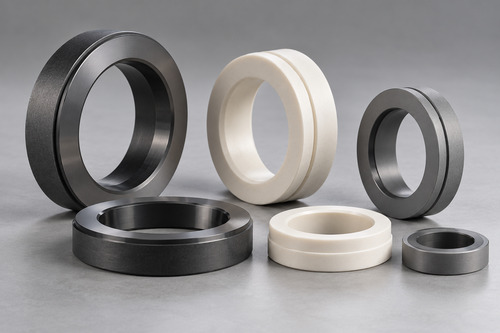
Pyrolytic boron nitride and hot-pressed boron nitride share the same basic chemistry, but they are not interchangeable forms of one material. PBN is deposited from a gas phase onto a mandrel. Hot-pressed BN starts as powder, is consolidated under pressure, and is usually machined from a plate, rod, or block. Those two manufacturing routes lead to different purity levels, shapes, wall thicknesses, grain orientation, and cost.
The distinction matters when a drawing calls out only "BN." A thin crucible for compound-semiconductor growth may depend on the purity and deposited structure of PBN. A heater support with holes, slots, and tight dimensional features may be more practical in a machinable hot-pressed grade. Substituting one for the other without reviewing the function can create a part that is either unsuitable or unnecessarily expensive.
Advanced Ceramic Materials (ACM) treats PBN and hot-pressed BN as separate material families rather than interchangeable versions of "BN." For an ACM quotation, the starting point is not nominal chemistry alone, but the manufacturing route, required geometry, service atmosphere, and acceptable contamination level.

The manufacturing route sets the first boundary
Pyrolytic boron nitride is produced by chemical vapor deposition. Boron- and nitrogen-containing gases react at high temperature, and BN builds up layer by layer on a shaped mandrel. After deposition, the mandrel is removed and the PBN shell is finished to its final dimensions.
This route can produce thin-walled crucibles, boats, tubes, and sheets without conventional sintering additives. Every deposited shape needs a suitable mandrel, so deep undercuts, heavy sections, and complex internal features are not natural fits.
Hot-pressed boron nitride custom parts are made from consolidated h-BN powder. Depending on the grade, the material may be self-bonded or contain an oxide, nitride, or ceramic addition. The blank is then machined into the required component. This is why hot-pressed BN is often the more direct route for spacers, insulators, supports, nozzles, and parts with drilled holes or milled features.

A practical comparison
|
Selection point |
||
|
Main manufacturing route |
Chemical vapor deposition on a mandrel |
Powder consolidation followed by machining |
|
Typical reason to choose it |
Very high purity, thin walls, clean vacuum service, deposited crucible geometry |
Machinability, broader geometry, thicker sections, multiple grade options |
|
Composition |
Normally no conventional sintering binder |
May be high-purity BN or a BN composite with additives |
|
Common forms |
Crucibles, boats, tubes, rings, sheets, heater structures |
Plates, rods, blocks, rings, nozzles, insulators, custom machined parts |
|
Important limitation |
Mandrel and deposition constraints; strong directional behavior |
Grade-specific binder, moisture, outgassing, and contamination limits |
|
Drawing priority |
Wall thickness, deposition direction, surface condition, allowable delamination |
Grade composition, blank orientation, machining details, edge limits |
Choose PBN when contamination control drives the decision
PBN is often selected for processes in which trace contamination matters more than machining flexibility. A PBN crucible can be formed directly as a thin deposited vessel without the binder phases used in many machinable BN grades. This makes PBN useful for crystal growth, molecular beam epitaxy, evaporation, and other vacuum processes that place a premium on purity.
Purity alone does not approve a crucible. The melt or evaporant, temperature, vacuum level, heating profile, fill volume, wall thickness, and expected number of runs still need review.
PBN also supports specialized layered structures. In a PBN-PG heater, pyrolytic graphite provides the conductive heating path while PBN provides electrical insulation and encapsulation. A machined hot-pressed BN block cannot replace that deposited multilayer construction by a simple material substitution.
Choose hot-pressed BN when geometry and machining matter more
Hot-pressed BN is usually the more practical starting point for a component with bores, slots, pockets, shoulders, or several mounting features. The material can be machined with conventional carbide tooling under controlled conditions, which helps with prototypes and low-volume custom parts.
The word "machinable" should not be read as "dimensionally unrestricted." Thin webs, sharp internal corners, fine threads, and unsupported edges can still chip. The blank direction also matters because plate-like BN grains tend to orient during pressing. A long, thin feature cut in the wrong direction may be less stable or more fragile than the same geometry oriented differently in the blank.
High-purity self-bonded h-BN is not the same as oxide-bonded BN, moisture-resistant BN, BN-AlN, or BN-ZrO2 composites. Additions may improve strength, humidity resistance, wear behavior, or heat transfer, but they also change purity, outgassing, and electrical properties. ACM therefore reviews a hot-pressed BN inquiry by application rather than selecting a grade from purity alone. A vacuum electrical insulator, a molten-metal component, and a part exposed to humid storage may require different BN formulations even when their drawings look similar. Buyers can review the available boron nitride grades and forms before submitting the drawing.
Case Study: A Request for "BN" That Actually Required PBN
A customer approached ACM for a cylindrical "BN crucible" and supplied an outside diameter, overall height, and required quantity. The initial request did not identify the BN type, operating atmosphere, material being heated, or acceptable impurity level. Based on the dimensions alone, ACM could not determine whether the part should be machined from hot-pressed BN or deposited as PBN.
Follow-up questions showed that the crucible would be used in a high-vacuum evaporation system. It would hold a high-purity source material through repeated heating cycles. The customer also wanted a thin wall to reduce thermal mass and was concerned that constituents from the crucible might enter the source material.
Those details shifted the recommendation toward PBN. The geometry did not require drilled holes, threads, or milled features that would justify machining a hot-pressed blank. More importantly, a deposited PBN crucible could provide the thin wall and binder-free construction required for the vacuum process.
The quotation was therefore revised from a generic BN crucible to a custom PBN crucible. The final specification recorded the inside diameter, usable depth, wall thickness, rim geometry, operating atmosphere, peak temperature, source material, and expected heating cycles. That information gave the production team a much clearer basis than the original description of "BN."
Both materials are anisotropic
PBN and hot-pressed h-BN contain layered crystal structures. Their thermal expansion, thermal conductivity, and mechanical behavior can differ substantially with direction. Published research on deposited PBN and textured hot-pressed h-BN confirms that microstructure and preferred orientation control these directional properties.
For PBN, the high-conductivity direction generally lies along the deposited layers, while heat transfer through the thickness is much lower. For hot-pressed BN, the pressing direction influences grain orientation. A datasheet value without a stated direction can therefore be misleading for a heat spreader, heater support, crucible wall, or electrical insulator.
Show the heat-flow direction and critical electric-field or load direction on the drawing. Ask how the quoted property was measured and how the finished part will be oriented relative to the deposition or pressing direction.
Do not copy a vacuum temperature into air service
Both materials can serve at very high temperatures in vacuum or inert gas, but oxygen-bearing environments introduce a different limit. Air, water vapor, residual oxygen, pressure, exposure time, and gas flow affect oxidation. A temperature statement that omits atmosphere and duration is incomplete.
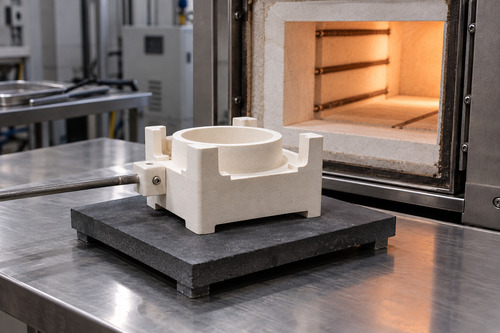
This is especially important when equipment cycles between vacuum and ambient conditions. Record whether the component is hot during venting, whether moisture can adsorb during shutdown, and whether deposits are cleaned between runs. For binder-containing hot-pressed BN, confirm how humidity and cleaning affect electrical insulation and surface condition.
Geometry creates different failure risks
PBN crucibles can retain residual stress from deposition and cooling. Research on PBN crucibles has shown that thermal anisotropy, wall thickness, and attachment to the mandrel influence the stress state. This is one reason a thicker wall is not automatically safer. Local thickness changes, rim geometry, and handling loads should be reviewed with the deposition process in mind.
Hot-pressed BN is more likely to be limited by machining damage, weak edges, blank orientation, or an unsuitable grade. Cracking at a clamp can indicate excessive assembly load or restricted thermal expansion rather than a need for a stronger binder.
What ACM Needs to Review a BN RFQ
To let ACM evaluate both the material grade and the manufacturing route, provide:
-
Required form: crucible, sheet, tube, ring, heater, plate, or machined component
-
Normal and peak temperature, dwell time, ramp rate, and number of cycles
-
Vacuum level or gas composition, including oxygen and moisture exposure
-
Materials in contact with the BN and acceptable contamination limits
-
Heat-flow, electrical-field, and mechanical-load directions
-
Critical dimensions, wall thickness, tolerances, surface condition, and edge limits
-
Cleaning method, venting sequence, handling method, and expected service interval
-
Prototype quantity, production quantity, and inspection requirements
For PBN, include the internal geometry and usable volume rather than only the outside envelope. For hot-pressed BN, specify the grade or the functional properties an alternate grade must meet. In both cases, avoid approving a substitute from color and nominal chemistry alone.
Final selection
Use PBN when the application needs very high purity, thin deposited walls, clean vacuum performance, or a PBN-PG layered heater. Use hot-pressed BN when the part needs machined features, thicker sections, faster prototyping, or a grade tailored for moisture resistance, strength, wear, or thermal behavior.
Then verify atmosphere, orientation, geometry, contacting materials, and inspection criteria. The correct choice is not "the better BN." It is the manufacturing route and grade that fit the part's actual function.
Advanced Ceramic Materials (ACM) supplies PBN materials and components, including crucibles, sheets, and heater structures, together with custom hot-pressed BN parts in multiple grade families.
Send ACM the drawing together with the operating atmosphere, temperature cycle, contacting materials, and contamination limits. These details allow the material grade, blank or deposition orientation, manufacturability, and inspection requirements to be reviewed before quotation.
References
-
L. Duclaux, B. Nysten, J.-P. Issi, and A. W. Moore, "Structure and Low-Temperature Thermal Conductivity of Pyrolytic Boron Nitride," Physical Review B 46, 3362–3367 (1992). https://doi.org/10.1103/PhysRevB.46.3362
-
J.-X. Xue, J.-X. Liu, B.-H. Xie, and G.-J. Zhang, "Pressure-Induced Preferential Grain Growth, Texture Development and Anisotropic Properties of Hot Pressed Hexagonal Boron Nitride Ceramics," Scripta Materialia 65(11), 966–969 (2011). https://doi.org/10.1016/j.scriptamat.2011.08.025
-
C.-K. Lin and C.-C. Wei, "Residual Stress and Strain in Pyrolytic Boron Nitride Resulting from Thermal Anisotropy," Journal of Materials Science 23, 3558–3564 (1988). https://doi.org/10.1007/BF01115748

{{item.content}}
LEVE A REPLY
{{item.children[0].content}}
{{item.content}}
LEAVE A REPLY
SUBSCRIBE OUR NEWSLETTER
 How to Choose a Metal Coated Ceramic Substrate
Choose a metal-coated ceramic substrate by comparing alumina, AlN, and Si3N4 bases, metal stacks, thickness, circuit layout, joining, and inspection needs.
READ MORE >